What you need
- Azimuth, elevation and skew for your address, taken from the table below or calculated
- A compass or phone, and the local magnetic declination
- A dish of at least 60 cm, better 80 cm, with a universal LNB
- A receiver or TV with an HD satellite tuner (DVB-S2) and a signal-quality display
1Which satellites sit at 19.2° East
19.2° East is not one satellite but a cluster that SES operates at the same orbital position, so that a single fixed dish sees all of them at once. As of November 2026 the channels are carried by Astra 1M (launched 2008), Astra 1N (2011) and Astra 1P, which was launched in June 2024 and took up service at the turn of 2024/25.
The older Astra 1KR and Astra 1L handed their channels over to Astra 1P from February 2025 and are now listed only for occasional use; Astra 1L was shifted to 19.4° East in March 2025. Astra 1Q is due to launch in 2027, and both newcomers are meant to keep the position running well into the 2040s. None of this affects viewers. The replacements take over at the same position, and the dish stays where it is.
The cluster is built around the German-speaking market, and every German channel is broadcast from here. A modest dish is therefore enough, and across this region the values sit close together.
2What you can watch without a subscription
The German public broadcasters are free and unencrypted in HD: Das Erste, ZDF, the regional third programmes such as WDR, NDR, BR or SWR, plus ZDFinfo, ZDFneo, 3sat and KiKA. The SD versions are gone. ARD switched them off on 7 January 2025, and ZDF and its sister channels followed on 18 November 2025, so an SD-only receiver shows none of them any more.
RTL, Sat.1, ProSieben and the other private networks are still free, but only in SD. Their HD versions are encrypted and sold in Germany as HD+, a paid package with an access card and a certified receiver or module. HD+ is not available in Austria or Switzerland; the equivalents there are HD Austria and Kabelio, with slightly different line-ups.
Austria's ORF 1, ORF 2, ORF III and ORF Sport+ are on 19.2° East in HD, but encrypted; decoding is tied to a household in Austria that pays the broadcasting fee and may not be used abroad. An unencrypted SD version of ORF 2, ORF E, blanks out rights-restricted programmes. The Swiss SRG channels are not on Astra at all: they come encrypted from Hotbird 13° East.
English-language television on 19.2° East is limited to international news. As of November 2026 the free list includes CNN International, Sky News International, Al Jazeera English, DW English, France 24 in English, TRT World, CNBC Europe, CGTN and Arirang TV. BBC One, ITV, Channel 4 and Channel 5 are not among them. They come from Astra 28.2° East, which the last step deals with.
3The values for 20 cities
For 20 cities in Germany, Austria and Switzerland the table gives azimuth, elevation and LNB skew at the city centre, worked out with the SatFinder App's formulas. The spread is narrow. Azimuth runs from 162.2° in Geneva to 176.2° in Vienna, elevation from 28.2° in Hamburg to 35.8° in Graz.
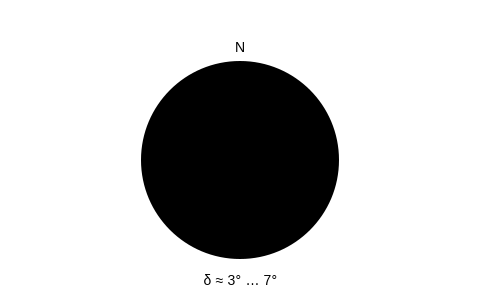
The azimuths are true bearings. A compass reads magnetic north, and in this region the two differ by a few degrees. On an 80 cm dish that is more than the whole usable window. The guide on magnetic declination explains the correction.
On the roof the order is elevation on the mount scale, a slow azimuth sweep, and the skew last. The step-by-step installation guide has the details.
| Location | Azimuth | Elevation | Skew |
|---|---|---|---|
| Basel (CH) | 164.4° | 34.2° | −2.9° |
| Berlin (DE) | 172.7° | 29.7° | 3.1° |
| Bern (CH) | 164.1° | 34.8° | −3.3° |
| Bremen (DE) | 167.1° | 28.6° | −0.2° |
| Cologne (DE) | 164.4° | 30.5° | −2.3° |
| Dresden (DE) | 173.0° | 31.3° | 3.1° |
| Düsseldorf (DE) | 164.2° | 30.2° | −2.3° |
| Frankfurt (DE) | 166.4° | 31.7° | −1.2° |
| Geneva (CH) | 162.2° | 35.3° | −4.7° |
| Graz (AT) | 174.9° | 35.8° | 4.0° |
| Hamburg (DE) | 168.6° | 28.2° | 0.8° |
| Hanover (DE) | 168.1° | 29.5° | 0.3° |
| Innsbruck (AT) | 169.4° | 35.1° | 0.4° |
| Leipzig (DE) | 171.3° | 30.9° | 2.1° |
| Munich (DE) | 169.8° | 34.2° | 0.7° |
| Nuremberg (DE) | 169.4° | 32.7° | 0.6° |
| Salzburg (AT) | 171.7° | 34.8° | 2.0° |
| Stuttgart (DE) | 166.8° | 33.2° | −1.2° |
| Vienna (AT) | 176.2° | 34.6° | 5.0° |
| Zurich (CH) | 165.7° | 34.6° | −2.2° |
4Dish size and LNB
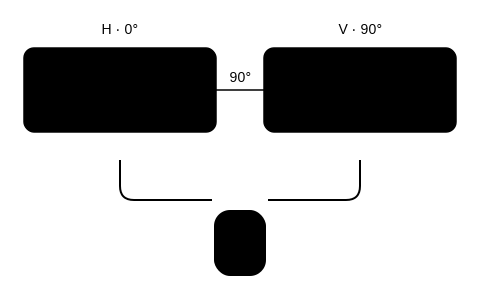
In Germany a 60 cm dish is enough for Astra 19.2° East. German installer guidance recommends 80 to 100 cm if you have the space and want a good reserve for bad weather; in a tight spot even 45 cm or a small flat antenna will do.
A standard universal LNB is all you need. It covers 10.70 to 12.75 GHz in two halves, a low band up to 11.70 GHz and a high band above it; the receiver selects the band with a 22 kHz tone and the polarisation, horizontal or vertical, via the supply voltage. The channels on 19.2° East use both bands and both polarisations, and even the English-language news channels alone are spread across them.
Single, twin, quad and octo LNBs differ only in the number of outputs. Choose one output for every tuner you want to feed: a twin for a recorder that records one channel while you watch another, a quad for several rooms.
5The pre-rotated skew: why it is nearly zero here
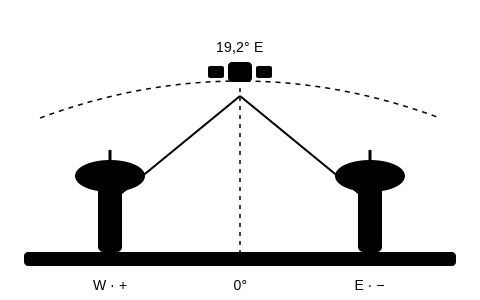
Skew is where 19.2° East differs most from what you may have learned elsewhere. SES transmits from this position with the polarisation plane already turned 7.5° clockwise, so that its core market needs almost no LNB rotation. Hanover needs 0.3°, Bremen −0.2°, Hamburg 0.8°, Munich 0.7°. Further east the value rises to 3.1° in Berlin and Dresden and 5.0° in Vienna; further west it turns negative, −2.3° in Cologne and −4.7° in Geneva.
A positive value is a clockwise turn, seen from behind the dish towards the satellite, and a negative one anticlockwise. The zero line runs through the middle of Germany, roughly from Bremen through Kassel and Würzburg to Augsburg.
This catches people out in two ways. Many online calculators leave out the 7.5° and show −4.4° instead of 3.1° for Berlin, −6.8° instead of 0.7° for Munich. And anyone who has aligned a dish in Britain will remember turning the LNB about 20° anticlockwise for Astra 28.2° East, a different satellite without pre-rotation, seen from much further west. Carried over to Munich, that habit leaves the LNB some 20° off. Either way, finish on signal quality, with one horizontal and one vertical channel.
6Hotbird 13° East and Astra 23.5° East: the neighbours
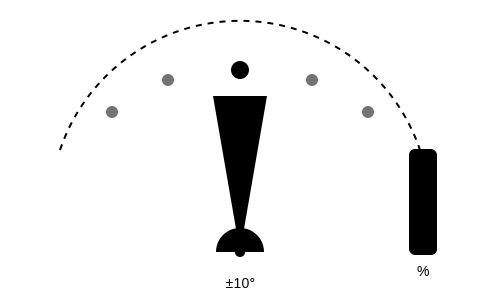
On a slow azimuth sweep a dish passes several satellites, and a signal meter reacts to each of them. The two you are most likely to lock onto by mistake are Hotbird 13° East, about 8° further west, and Astra 23.5° East, about 5° further east. From Munich, Hotbird sits at 178.1°, Astra 19.2° at 169.8° and Astra 23.5° at 164.2°; from Cologne at 172.2°, 164.4° and 159.1°. Elevation differs by only one or two degrees, so the mount scale will not tell you which one you have.
The channel search will. Hotbird carries the encrypted Swiss SRG channels, a few free RAI channels and many services from Poland and the Middle East. Astra 23.5° East carries packages for the Netherlands (Canal Digitaal) and for the Czech Republic and Slovakia (Skylink). If the list fills with those while Das Erste HD and ZDF HD are missing, the dish is on the wrong satellite. Check with one of them before you tighten anything.
In Switzerland the neighbour is often wanted, because SRG's channels come only from Hotbird. Many Swiss dishes therefore carry two LNBs side by side for Astra and Hotbird, joined to one cable by a DiSEqC switch. Each LNB needs its own skew.
7British TV: 28.2° East, and mostly out of reach
BBC One, ITV, Channel 4 and Channel 5 are free-to-air, but from Astra 2E, 2F and 2G at 28.2° East, on a UK spot beam focused tightly on the British Isles. In the far west of Germany, around Cologne and Bonn, a 60 to 80 cm dish still picks them up. Further east the dish you need grows quickly: in central Germany stable reception would probably take more than 3 metres, and in the eastern two-thirds of the country the UK beam is practically impossible to receive.
The Europe beams of 28.2° East reach all of Germany but carry mostly niche, shopping and non-English channels. Anyone in Berlin, Munich, Vienna or Zurich who wants BBC and ITV will not get them from a dish. In the far west, one dish can take both positions with a second LNB; they sit 9° apart.
The guide Aligning to Astra 28.2° East has that satellite's values from the British side. Its step on Astra 19.2° East outside Germany, Austria and Switzerland has a table for cities from Amsterdam and Paris to Warsaw, Budapest, Milan and the Spanish coast.
Frequently asked questions
How do I align a dish to Astra 19.2° East in Germany?
You need azimuth, elevation and LNB skew for your address. In Germany the azimuth lies between about 164° in the west and 173° in the east, elevation between about 28° in Hamburg and 34° in Munich, and the skew between about −2.3° and 3.1°, because Astra pre-rotates its polarisation by 7.5°. Set elevation first, sweep the azimuth slowly, set the skew and finish on signal quality.
Can I watch BBC or ITV through Astra 19.2° East?
No. BBC One, ITV, Channel 4 and Channel 5 come from Astra 28.2° East on a UK spot beam. Around Cologne and Bonn that beam still arrives with a 60 to 80 cm dish; in the eastern two-thirds of Germany reception is practically impossible. On 19.2° East you only get English-language international news channels.
Which English-language channels are free on Astra 19.2° East?
As of November 2026 they are international news services: CNN International, Sky News International, Al Jazeera English, DW English, France 24 in English, TRT World, CNBC Europe, CGTN and Arirang TV. Line-ups change, so check a current frequency list if a particular channel matters to you.
Why is the skew for Astra 19.2° East almost zero in Germany?
Because SES transmits from 19.2° East with the polarisation plane pre-rotated by 7.5° clockwise. That moves the zero line into central Germany: Hanover needs 0.3°, Munich 0.7°, Berlin 3.1°, Cologne −2.3°, Vienna 5.0°. Calculators that leave the offset out show values about 7.5° more negative, for Berlin −4.4°.
Do I need HD+ to watch German TV in HD?
Only for the private channels. ARD, ZDF and the other public channels are free in HD; their SD versions ended in 2025. RTL, Sat.1, ProSieben and the other private networks are free only in SD; their HD versions need HD+ in Germany, HD Austria in Austria or Kabelio in Switzerland.
How do I know whether my dish is on Astra 19.2° or on Hotbird or Astra 23.5°?
By the channel list, not the signal meter. Astra 19.2° East has Das Erste HD and ZDF HD; Hotbird 13° East, about 8° further west, has Italian, Polish and encrypted Swiss channels; Astra 23.5° East, about 5° further east, has Dutch and Czech-Slovak packages. Elevation is almost the same for all three.