What you need
- Your azimuth, elevation and skew, either from the table below or calculated for your exact address
- A compass or smartphone, plus the magnetic declination where you live
- A receiver that shows signal quality and can run a channel scan, so you can recognise 13° East by its channels
- Spanners for the mast clamp, elevation bolts and LNB holder
1What sits at 13° East: Hotbird 13F and 13G
Two satellites share the 13° East slot today: HOTBIRD 13F and HOTBIRD 13G. Both were built by Airbus Defence and Space and launched on 15 October and 3 November 2022. They entered service in 2023 and, according to Eutelsat, replaced the three satellites that previously occupied the position, which were freed up for other missions. As of November 2026, Eutelsat's page for 13° East names the two new craft.
As a viewer you will not notice the change. The position is still called Hotbird 13° East, and the dish aims at the same spot in the sky as before. Older guides that mention Hotbird 13B, 13C or 13E still have the right angles; only the satellite names are out of date. 13G, incidentally, also carries a payload for EGNOS, the European correction system for satellite navigation.
Eutelsat calls the coverage a "widebeam": one large Ku-band footprint stretching from western Europe and North Africa as far as Moscow and Dubai. The signal is strongest in an oval centred on France and Italy, marked 53 dBW on Eutelsat's map. The British Isles sit on its north-western side. The strongest contours reach southern England at most, while northern England, Scotland and Ireland lie a few contour steps further out.
2What is broadcast, and for whom
Eutelsat's 2026 brochure, based on 2025 data, quotes around 950 TV channels on Hotbird, more than 250 of them free-to-air, in 37 languages and on seven major pay-TV platforms. Each platform serves one home market: Wikipedia lists packages aimed at Italy, Poland, France, Belgium, Greece and Cyprus, Ukraine, Bulgaria and Switzerland.
Seen from Britain and Ireland, Hotbird complements Sky or Freesat rather than replacing it. It matters most to households with roots in Italy, Poland, Greece or another country in the footprint, and to French speakers.
Before anything else, find out whether the channel you want is free-to-air or part of a package. Pay-TV packages are sold for their home country, and whether a card may be used abroad is for the provider to decide, not your dish. Line-ups change constantly; a channel scan after installation is more reliable than an old list.
3What dish size you need in the UK and Ireland
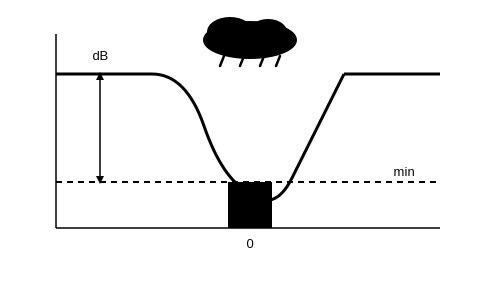
Eutelsat states that direct-to-home reception in the beam centre is possible with antennas smaller than 70 cm, and with slightly larger ones throughout Europe. The British Isles are not the beam centre, so plan larger, and larger still the further north and west you are, where the footprint weakens.
An installers' dish-size guide on the UK forum World of Satellite (2011, written for the previous Hotbird satellites) put the south-east of England at 50 to 60 cm and said Scotland, Northern Ireland and the Irish Republic need a dish roughly 30 to 40 per cent larger. Treat these as fair-weather minimums, not as a target.
What a bigger dish mainly buys is margin. Under a clear sky the picture hardly improves, but when heavy rain or wet snow weakens the signal, the larger reflector keeps you above the reception threshold. The same applies if Hotbird is the second, off-centre LNB on a multifeed dish, because an LNB beside the focal point makes less use of the reflector.
4Azimuth, elevation and skew for Hotbird in your city
Each of the 18 cities in the table, from across Great Britain and Ireland, is calculated for its centre. Azimuths are true values. Magnetic declination is close to zero here at the moment, from about one degree east in London to one or two degrees west in Ireland, yet with a beam only about two degrees wide even that counts.
Hotbird is often described as "due south", which is true for central Europe but not here. From the British Isles it lies to the south-south-east: 165.4° in Norwich, 163.4° in London, 161.3° in Manchester, 159.4° in Glasgow, 156.5° in Dublin and 153.4° in Cork. The further west you are, the further east of south you have to point. Compared with Astra 28.2° East, your Sky satellite, Hotbird sits about 17 to 18 degrees further west; compared with Astra 19.2° East, about seven degrees further west.
Elevation runs from 23.6° in Aberdeen to 30.1° in Southampton, with London at 29.8° and Dublin at 26.5°. That is noticeably higher than Astra 28.2° East from the same places (London 25.4°), because 13° East lies closer to your own longitude. In Scotland, though, 24 degrees is still a low line of sight.
Setting the values on the dish (elevation on the scale, then azimuth, then skew) works as for any satellite and is explained in the main guide to aligning a satellite dish. This page sticks to what is different about 13° East.
| Location | Azimuth | Elevation | Skew |
|---|---|---|---|
| Aberdeen | 162.2° | 23.6° | −6.0° |
| Belfast | 157.2° | 25.4° | −9.4° |
| Birmingham | 161.5° | 28.4° | −7.6° |
| Bristol | 160.4° | 29.3° | −8.5° |
| Cardiff | 159.7° | 29.1° | −9.0° |
| Cork | 153.4° | 27.3° | −12.5° |
| Dublin | 156.5° | 26.5° | −10.3° |
| Edinburgh | 160.7° | 24.6° | −7.1° |
| Glasgow | 159.4° | 24.5° | −7.8° |
| Leeds | 162.2° | 27.1° | −6.9° |
| Liverpool | 160.4° | 27.2° | −8.0° |
| London | 163.4° | 29.8° | −6.7° |
| Manchester | 161.3° | 27.3° | −7.5° |
| Newcastle upon Tyne | 162.3° | 25.9° | −6.5° |
| Norwich | 165.4° | 28.9° | −5.3° |
| Plymouth | 158.2° | 30.0° | −10.2° |
| Sheffield | 162.2° | 27.6° | −7.0° |
| Southampton | 161.7° | 30.1° | −7.9° |
5Skew: why Eutelsat's 3.5-degree offset changes the numbers
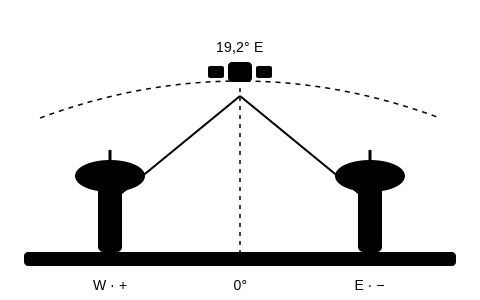
Eutelsat does not transmit with the polarisation lined up exactly with the equator. It pre-rotates it by 3.535° clockwise, as seen looking at the satellite from the earth. That is laid down in its earth-station handbook ESOG 120 (June 2024 edition), whose table lists the earlier Hotbirds 13B, 13C and 13E with exactly that value. The new 13F and 13G are not listed yet. The table above assumes they kept the position's offset, which is not documented; fine-tuning on signal quality will show whether the value holds.
The whole of Britain and Ireland lies far west of 13° East, so the skew is negative everywhere: the LNB is turned anticlockwise as seen from behind the dish. In the table cities it runs from −5.3° in Norwich to −12.5° in Cork, with London at −6.7°, Manchester −7.5°, Glasgow −7.8° and Dublin −10.3°. The further west you are, the larger the angle.
This is where online calculators part company. A tool that only applies the geometry shows about 3.5 degrees more anticlockwise rotation: −10.2° instead of −6.7° for London, −13.8° instead of −10.3° for Dublin, −16.0° instead of −12.5° for Cork. Others count anticlockwise as positive and flip the sign. The table here already includes the offset, so do not subtract it a second time.
Anyone who also wants Astra 19.2° East benefits from a coincidence. SES pre-rotates that position by 7.5°, and from the British Isles the two effects almost cancel out. In every city in the table the skew for Astra 19.2° East is within 0.6 degrees of the Hotbird value (London −7.2° against −6.7°, Dublin −10.2° against −10.3°).
6Telling Hotbird apart from Astra 19.2° East and the 10° and 16° East neighbours
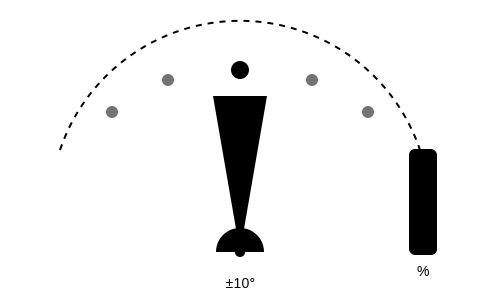
Three positions sit close together in the sky: 10° East, Hotbird 13° East and 16° East. Three degrees in orbit become three and a half to four degrees of azimuth on the ground. From London, 10° East is at 167.1°, Hotbird at 163.4° and 16° East at 159.7°. With an 80 cm dish the beam is about two degrees wide, so a hurried sweep goes straight past Hotbird and stops on a neighbour.
The tricky one is 16° East. EUTELSAT 16D broadcasts there for central and eastern Europe, and Eutelsat says over 25 million homes in central Europe are equipped to receive it. Your receiver will find pictures there, just not the ones you are looking for. 10° East, according to Eutelsat, is mainly a position for data services and professional video; a channel scan there turns up little that looks familiar.
Astra 19.2° East, about seven degrees further east from these islands, is too far away to hit by a small slip. You do pass it, though, when you sweep west from your Sky direction.
What settles it is the content. Run a channel scan and compare the result with a current channel list for 13° East; signal strength on its own cannot tell the positions apart.
7Hotbird and Astra 19.2° East on one dish
Some viewers want 13° East as well as Astra 19.2° East. One fixed dish with two LNBs, known as a multifeed, can do it. One LNB sits at the focal point and the second beside it, "squinting" at the other position. The two positions are 6.2 degrees apart.
For the skew, each LNB gets its own value. As the skew section shows, from Britain and Ireland the two values are almost identical, so both LNBs end up turned by practically the same angle. On a monoblock LNB, which combines both receiving units in one housing, you set the mean of the two.
Bracket, LNB positions and dish size will be covered in a separate multifeed guide. Until then, one planning point: the line of sight has to be clear across both directions, about seven degrees of azimuth, before you drill.
Frequently asked questions
How do I align my dish to Hotbird 13° East from the UK?
Point the dish south-south-east, at about 153 to 165 degrees depending on where in Great Britain or Ireland you are, with an elevation between about 24 and 30 degrees. The LNB skew is −5 to −12.5 degrees, an anticlockwise turn as seen from behind, with Eutelsat's 3.535-degree polarisation offset already included. Then run a channel scan to make sure you are on 13° East and not on 16° East.
Which satellites are at Hotbird 13° East?
As of November 2026, HOTBIRD 13F and HOTBIRD 13G, launched in October and November 2022 and in service since 2023. According to Eutelsat they replaced the three older satellites at the position. The dish still aims at the same point in the sky, so angles from older guides remain valid.
What size dish do I need for Hotbird in the UK or Ireland?
Eutelsat says dishes under 70 cm work in the centre of the footprint and slightly larger ones elsewhere in Europe. The British Isles are on the north-western side of the footprint, so plan larger the further north and west you are. A 2011 UK forum guide for the earlier Hotbirds gave 50 to 60 cm for south-east England and 30 to 40 per cent more for Scotland and Ireland, as minimums.
Why does my skew calculator show different values for Hotbird?
Many calculators use only the geometric formula and leave out Eutelsat's polarisation offset of 3.535 degrees clockwise, documented in its ESOG 120 handbook. Without it a calculator shows −10.2° for London instead of −6.7°, and −13.8° for Dublin instead of −10.3°. Some tools also count anticlockwise as positive; what matters is the direction as seen from behind the dish.
How do I know I have found Hotbird and not 16° East?
The channels tell you; signal strength does not. 16° East and 10° East sit about three and a half to four degrees of azimuth either side of Hotbird and also deliver strong signals. Run a channel scan: if the channels listed for 13° East appear, you are on the right satellite. If you mostly find central and eastern European channels, you are probably on 16° East and need to move slightly to the right as seen from behind.
Can I get Hotbird and Astra 19.2° East on one dish?
Yes, with a multifeed: one fixed dish with two LNBs, one at the focal point and one beside it. The two positions are 6.2 degrees apart. From Britain and Ireland their skew values are within 0.6 degrees of each other, so both LNBs need almost the same rotation. Check the line of sight across both directions, about seven degrees of azimuth, before mounting.