What you need
- A receiver or television with a signal display in its installation or antenna menu
- The transponder details of a known channel: frequency, polarisation and symbol rate
- A note for baseline readings: strength, quality, date and weather
- Optionally a meter showing level in dBµV and MER or C/N in dB
1What the strength bar measures
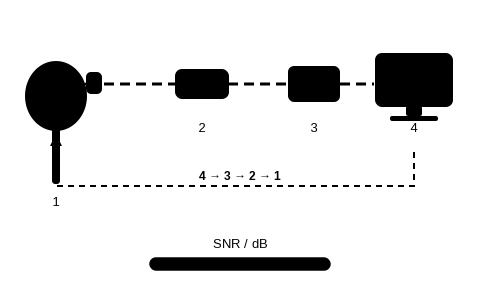
The strength bar, called signal, level or AGC in some menus, measures power at the tuner input: the satellite IF, which the LNB has converted down from the Ku band (10.7 to 12.75 GHz) to roughly 1 to 2 GHz, amplified and sent down the cable. The tuner does not distinguish between power from a satellite and power that is just noise.
And plenty of noise arrives. The LNB amplifies not only the satellite signal but also its own noise and the thermal radiation of whatever the dish is looking at. So the strength reading rises as soon as the LNB is powered, and further when the dish points at a wall, roof or tree instead of the cold sky, because warm surfaces radiate more noise. A high strength bar proves only that cable and LNB work, not that a satellite has been found.
Meters show the level in dBµV. The European standard EN 50083 set a window of 47 to 77 dBµV at the wall outlet; in practice about 42 to 65 dBµV at the receiver input is regarded as trouble-free, because modern tuners are sensitive and struggle more with too much level than too little. An LNB delivers roughly 75 dBµV, and the cable loses about 20 to 30 dB per 100 metres at these frequencies.
2What the quality bar measures
The quality bar is about something else, namely how far the wanted signal stands out from the noise. Behind it is a signal-to-noise figure in decibels, called C/N (carrier to noise), SNR or MER (modulation error ratio) depending on the device. The tuner can only calculate it while actually demodulating a transponder. Without a satellite there is nothing to demodulate, so quality sits at zero, however much noise arrives.
MER is the easiest to picture. The receiver knows where the symbols of a QPSK or 8PSK modulation ought to land and measures how far the received symbols miss. The power of the ideal symbols divided by the power of those errors, in dB, is the MER. According to the ETSI guidelines TR 101 290 it captures all degradation at the receiver's decision stage, noise and distortion alike. With noise as the only impairment, SNR and MER are equal.
BER (bit error rate) counts wrongly detected bits; 1.0E-5 means one bad bit in a hundred thousand, and the value depends on where in the error correction it is measured. For DVB-S, EN 300 421 sets the benchmark: 2 × 10⁻⁴ after the Viterbi decoder is enough for the second correction stage to deliver quasi error-free output, less than one uncorrected error per hour.
3S and Q, level and quality, SNR and BER: the labels
Manufacturers label the same two measurements differently. S, signal, strength, level or AGC mean power at the input. Q, quality, SNR, C/N or MER mean the signal-to-noise ratio. BER appears mainly on meters and on receivers with a detailed signal menu.
Percentages cause the biggest misunderstanding. No standard defines which dB value corresponds to 50 or 80 per cent; each manufacturer picks its own scale. Even the Linux driver interface for TV tuners offers, besides real decibel values, a relative scale from 0 to 100 per cent with no defined reference. Seventy per cent on one box may mean more or less margin than fifty on another.
Percentages are comparable only on the same device, on the same transponder and with the same software. If a new box suddenly shows “only 60 per cent”, reception has not necessarily got worse; the scale has changed. For an honest comparison you need dB values.
4Full strength, zero quality: telling the causes apart
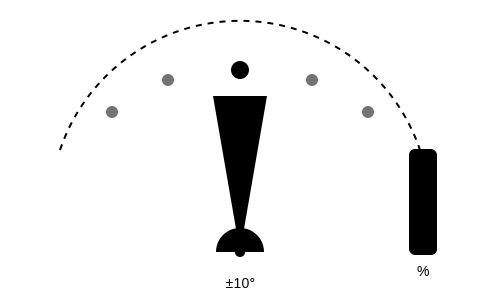
Decent strength with zero quality means power is arriving but the tuner finds nothing to demodulate on the tuned frequency. The causes fall into three groups: the dish is not on the right satellite, the receiver is looking in the wrong place, or the signal is distorted so badly on its way that it can no longer be read.
The commonest case is a dish sitting between two satellites or on the wrong one. On the arc, Badr at 26° East is only 2.2 degrees from Astra 28.2° East, Astra 23.5° East 4.7 degrees. On a neighbour whose signal reaches you, quality appears but the scan finds unfamiliar channels; between satellites or facing a tree, quality stays at zero. The second group is receiver settings: wrong LNB type or oscillator frequencies (9750 and 10600 MHz for a universal LNB), a missing 22 kHz tone, which switches the LNB to the high band above 11.7 GHz, or the wrong DiSEqC input on a multi-LNB setup. Wrong polarisation or skew usually hits one plane only.
The third group is rarer. An LNB whose oscillator is no longer accurate shifts every frequency. An unnecessary amplifier can overload the tuner, creating intermodulation products that bury the signal while strength sits at the top. A corroded F-connector or kinked cable may still pass the supply voltage but cause reflections that drive up the bit error rate. The table sorts the cases by display pattern.
If a single channel shows zero, it has usually moved; that case and the chain check are covered in “No satellite signal”.
| Display | Likely cause | Next step |
|---|---|---|
| Strength zero, quality zero | No power to the LNB: cable, connector, outlet or power supply | Check the chain backwards (see “No satellite signal”) |
| Strength high, quality zero on every transponder | Dish pointing between two satellites or into an obstruction | Check the line of sight and the elevation, then sweep the azimuth slowly |
| Quality present, but the scan finds unfamiliar channels | Dish is on a neighbouring satellite | Compare the azimuth with the calculated values and correct it |
| Quality only on frequencies below 11.7 GHz | 22 kHz tone missing or LNB not switching to the high band | Set 22 kHz to automatic in the receiver, check switches and multiswitch |
| Quality zero although the alignment is known to be right | Wrong LNB type, oscillator frequency or DiSEqC input | Select a universal LNB with 9750/10600 MHz, test DiSEqC inputs one by one |
| One polarisation plane clearly worse than the other | Skew wrong or LNB in the wrong seating | Turn the LNB to the calculated skew and compare both planes |
| Strength at maximum, quality moderate and unsteady | Overload from an amplifier or a very high level | Remove the amplifier or try an attenuator |
| Quality jumps when the cable is moved | Corroded F-connector or kinked cable | Refit the connector, replace the cable section |
| One channel at zero, all others fine | Channel has changed frequency or transponder | Rescan with an up-to-date transponder list |
5Why quality fluctuates
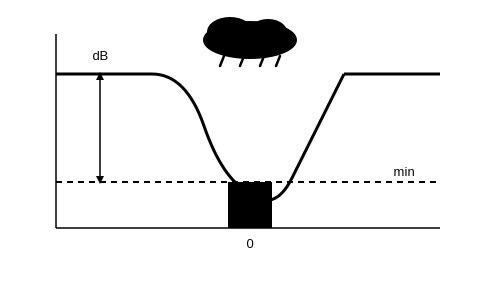
When the weather changes, strength often stays put while quality does not. Rain attenuates the Ku-band signal but not the LNB's own noise, so the signal-to-noise ratio shrinks. The heavier the shower and the flatter the dish points, the more it costs, because at low elevation the path through the rain is longer. Across Britain and Ireland, Astra 28.2° East sits only about 20 to 25 degrees above the horizon.
Wet snow on the reflector or LNB cover absorbs the signal at the dish; brushing it off helps at once. A tree at the edge of the line of sight brings fluctuations with wind and season: bare in winter, in leaf in summer, denser still when wet. A loose mast shows up as quality twitching with the gusts.
Sun outage is the only dropout in which strength rises. Twice a year, in February and March before the equinox and in September and October after it, the sun stands directly behind the satellite for a few minutes on several consecutive days. Its noise drowns the signal for twelve minutes at most; the larger the dish, the shorter the effect.
6The digital cliff and how much margin is enough
Digital television has no slowly worsening picture. Above the threshold, error correction fixes almost everything; below it, errors climb steeply and the picture breaks into blocks and freezes. TR 101 290 names exactly that steepness as the reason why noise margin is a more useful measure than bit error rate: the BER says little about how much headroom is left.
The threshold depends on the transponder's modulation and code rate, chosen by the broadcaster. For quasi error-free reception under ideal conditions, the DVB-S2 standard EN 302 307 lists these values of Es/N0, which comes close to a receiver's SNR reading: QPSK 3/4 needs 4.03 dB, QPSK 9/10 6.42 dB, 8PSK 2/3 6.62 dB, 8PSK 3/4 7.91 dB and 8PSK 9/10 10.98 dB. Real receivers need a little more, because these figures are simulated without phase noise and with perfect synchronisation.
Margin is the gap between the clear-sky reading and that threshold. If your receiver shows 11 dB on an 8PSK 2/3 transponder, a good 4 dB remains on paper, some of which the receiver itself uses up. No single figure is enough everywhere; what a shower costs depends on rainfall, elevation and dish size. Without a dB display, a small test movement helps. If the picture breaks up as soon as the dish is nudged slightly, the installation is on the edge.
7Fine-tuning on quality
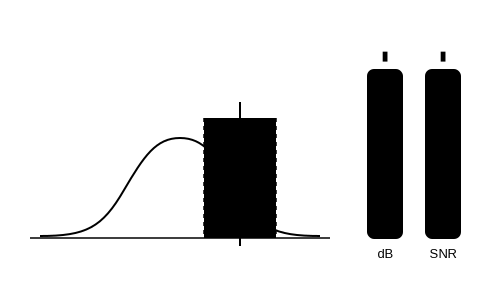
For the last tenths of a degree only quality will do. Strength barely changes as you turn, because noise makes up much of it; quality responds clearly as the satellite moves into the centre of the reception window. The SatFinder App gives the starting values for your address, and the quality reading does the rest. Keep the display on one fixed transponder throughout.
Many receivers update the display with a delay, so turn in small steps and wait until the figure settles. Rather than hunting for the maximum, which is often broad and flat, find the two edges: turn one way until quality drops noticeably and mark the mast, then the other way and mark again. The right position is midway between the marks. Do the same for elevation.
The skew comes last. Compare a horizontal and a vertical transponder and turn the LNB until both together read best. Then tighten every bolt and read the quality again, because a dish likes to shift by exactly what you have just gained. Note the final value with transponder, date and weather; it is your reference for any later deterioration.
Frequently asked questions
Why does signal quality drop to zero when signal strength is full?
Strength measures all the power at the tuner input, including noise amplified by the LNB. Zero quality means the tuner finds nothing to demodulate. Common causes: the dish points between two satellites or into an obstruction, the receiver's LNB type or DiSEqC input is wrong, or the 22 kHz tone for the high band is missing. Check the receiver first, then the alignment.
What do S and Q mean in satellite reception?
S is signal strength, the level of the satellite IF at the receiver input, in dBµV or as a percentage. Q is signal quality, the ratio of wanted signal to noise, shown as SNR, C/N or MER in dB or as a percentage. Q decides whether you get a picture; S mainly shows that cable and LNB work.
What percentage of signal quality is good?
There is no universal figure, because every manufacturer sets its own scale. What matters is the margin above the transponder's threshold. If the receiver shows dB, subtract the threshold for the modulation; if it shows only percentages, check how far the dish can be turned before the picture breaks up.
What SNR does DVB-S2 need?
It depends on modulation and code rate. Under ideal conditions EN 302 307 gives, for example, 4.03 dB for QPSK 3/4, 6.62 dB for 8PSK 2/3 and 7.91 dB for 8PSK 3/4. Real receivers need a little more. Everything above that is margin for rain, snow and foliage.
Why does signal quality fluctuate when I have not changed anything?
Rain and wet snow attenuate the Ku band while the LNB's noise stays the same, so the signal-to-noise ratio falls. Trees at the edge of the line of sight sway with wind and foliage, a loose mast with the gusts. In February–March and September–October the sun also stands behind the satellite for a few minutes on several days.
Should I align the dish on signal strength or signal quality?
On signal quality. Strength barely changes as you turn, because much of it is noise, and even rises when the dish faces a warm wall. Find the two points where quality drops noticeably and set the dish in the middle between them.