What you need
- The values for your location: azimuth, elevation and LNB skew for 7.0° West
- A dish sized for your region – about 60 cm in the core of the footprint, a metre or more at the edges and in Europe
- A compass or smartphone, read against the magnetic azimuth rather than the true one
- A receiver that shows signal quality and lets you enter a transponder by hand
- A current transponder list for 7° West, for example from KingOfSat or LyngSat
1Who broadcasts from 7° and 8° West
“Nilesat 7° West” is everyday shorthand for a cluster of satellites run by two operators. Nilesat, the Egyptian satellite company, operates Nilesat 201 and Nilesat 301 at 7.0° West. Next to them sits Eutelsat 7 West A, launched in 2011. Eutelsat markets it as a 7° West satellite; the satellite table in Eutelsat's operator handbook ESOG 120 gives its position as 7.3° West.
One degree further west, at 8° West, Eutelsat 8 West B has been in service since its launch in 2015. Eutelsat sells the two slots together as the “7/8° West” neighbourhood and names Nilesat as its partner there. One alignment picks up both 7.0° and 7.3° West; 8° West is a separate target.
Most of the channels do not actually come from the Nilesat craft. As of November 2026 the KingOfSat database counts 431 channels on Eutelsat 7 West A, 238 on Nilesat 201 and 102 on Nilesat 301, with another 394 on Eutelsat 8 West B. In practice you are aiming at four active satellites on three longitudes.
2Footprints and programmes
Every satellite in the cluster is built for the Middle East and North Africa. LyngSat lists the Ku-band TV beams of Nilesat 201 and 301 over that region. Eutelsat 7 West A has a beam for the Middle East and North Africa and a second one for north-west Africa, reaching from the Maghreb down to the Gulf of Guinea. Eutelsat 8 West B covers the same core region with its main beam and adds further beams, among them one for Europe.
On the published maps of the Middle East beams, the contours stop at Europe's Mediterranean coast. London, Paris and Berlin lie outside them, not on the edge. What reaches Europe is the spill beyond the planned area, and its strength is not shown on any official map.
The programming is overwhelmingly Arabic-language and free-to-air. Eutelsat quotes more than 850 TV channels at 7/8° West, 92 percent of them free-to-air and 390 in HD, and some 70 million homes in the Middle East and North Africa receiving the position. KingOfSat also lists channels in English, French, Kurdish, Farsi and Amharic, among others. The line-up changes constantly; all figures are as of November 2026.
3Dish size: from the core of the footprint to London
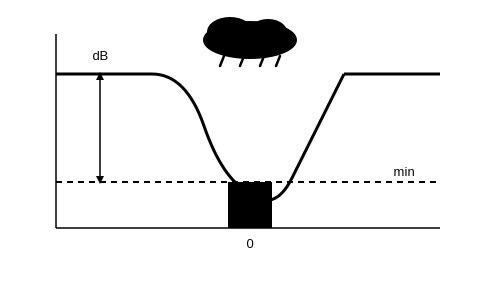
Inside the footprint, Nilesat is easy. For the Middle East and North Africa beam of Nilesat 301, LyngSat gives 55–65 cm where the satellite delivers 49 dBW and 95–120 cm at the 44 dBW edge. Across most of North Africa and the Arabian Peninsula an ordinary dish of around 60 to 80 cm is therefore enough; towards the edges of the beam you need more.
In Europe there is no official size, because you are outside the coverage area. What exists are reception reports, and they are old. A 2007 forum thread from England describes a 1.8 m dish in Essex receiving all horizontal and vertical transponders, while a 1.2 m dish got the vertical ones only. A European satellite overview last updated in February 2014 puts Nilesat at roughly 1 m in southern and 1.5 m in northern Europe; its author received a few transponders in northern Germany with 105 cm, on an unstable signal. Nilesat 301 has joined the position since, and nobody publishes how strong today's satellites are over Europe.
Before buying, take a sober view. In London, Paris or Berlin plan for at least a metre, count on only part of the line-up working and on dropouts in heavy rain. A standard Sky or Freesat minidish will not do. If the channels you want are also carried on a position with a European beam, that is usually the more reliable route.
4The values for your city
All values in the table refer to 7.0° West and to the city centre, and they come from the formulas the SatFinder App uses. Azimuths are true bearings, so correct for local magnetic declination before reading them off a compass.
Because the satellite hangs above the Atlantic off Morocco, the direction swings a long way across the region. Casablanca looks almost due south at 178.9°, Algiers at 196.5°, Tunis at 207.3°. From Cairo the dish points south-west at 237.6°, from Riyadh at 252.9° and from Muscat almost due west-south-west at 259.6°. A value borrowed from another country misses the satellite completely.
For Europe the dish turns south-south-west: 188.8° in London, 192.3° in Paris and 205.1° in Berlin, at elevations of 30.7°, 33.2° and 27.0°. That is much further west than the Astra and Hotbird positions most dishes there already face. The mounting is no different from any other position, and the main alignment guide has the sequence.
| Location | Azimuth | Elevation | Skew |
|---|---|---|---|
| Cairo (EG) | 237.6° | 35.8° | 46.9° |
| Alexandria (EG) | 235.4° | 36.1° | 44.8° |
| Riyadh (SA) | 252.9° | 24.7° | 60.3° |
| Jeddah (SA) | 250.6° | 32.8° | 61.4° |
| Dubai (AE) | 257.4° | 16.6° | 62.0° |
| Abu Dhabi (AE) | 257.3° | 17.6° | 62.6° |
| Doha (QA) | 255.3° | 20.0° | 61.0° |
| Kuwait City (KW) | 251.0° | 21.9° | 55.5° |
| Manama (BH) | 254.3° | 20.6° | 59.7° |
| Muscat (OM) | 259.6° | 14.0° | 64.3° |
| Amman (JO) | 240.3° | 31.0° | 47.5° |
| Beirut (LB) | 238.7° | 30.2° | 45.2° |
| Baghdad (IQ) | 246.3° | 23.5° | 49.9° |
| Khartoum (SD) | 252.1° | 41.5° | 66.5° |
| Tripoli (LY) | 214.1° | 46.0° | 28.1° |
| Tunis (TN) | 207.3° | 43.6° | 21.5° |
| Algiers (DZ) | 196.5° | 46.1° | 13.2° |
| Casablanca (MA) | 178.9° | 51.0° | −0.9° |
| London (UK) | 188.8° | 30.7° | 5.4° |
| Paris (FR) | 192.3° | 33.2° | 8.1° |
| Berlin (DE) | 205.1° | 27.0° | 15.0° |
5Low in the sky: the Gulf and Oman
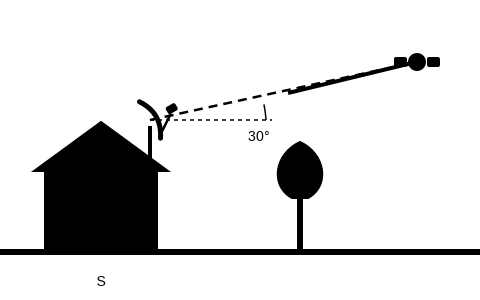
The further east you live, the lower 7° West sits. Casablanca has 51.0° of elevation and Tripoli 46.0°, Cairo still 35.8°. On the Gulf it drops sharply: 21.9° in Kuwait City, 20.0° in Doha, 16.6° in Dubai and only 14.0° in Muscat. At those angles the line of sight runs just above neighbouring roofs.
In a city of towers, a building several streets away can block the satellite. Before drilling, check the view towards the west-south-west at the exact elevation; a balcony facing the wrong way or a parapet a little too high rules a spot out whatever the dish size.
6Skew: from nearly zero in Morocco to over 60° in the Gulf
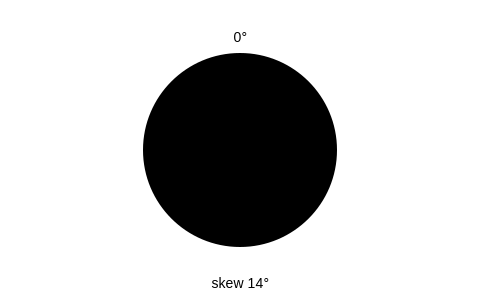
Skew depends on how far east or west of the satellite's longitude you are. Casablanca lies just west of it, so the value is small and negative: −0.9°. Moving east it grows steadily: 13.2° in Algiers, 21.5° in Tunis, 46.9° in Cairo, 55.5° in Kuwait City, 62.0° in Dubai and 64.3° in Muscat. Khartoum, far to the south-east, needs 66.5°. The values are positive for a clockwise turn, seen from behind the dish.
In Europe the values stay moderate: 5.4° in London, 8.1° in Paris and 15.0° in Berlin. At more than 60 degrees in the Gulf, by contrast, the LNB lies almost on its side. If your holder's scale stops short, mark the angle on the neck with tape rather than guessing.
According to Eutelsat's handbook, Eutelsat 7 West A and 8 West B transmit with the polarisation plane pre-rotated by +3.535°, whereas no such offset is published for the Nilesat satellites. The table calculates 7.0° West without it. For channels on Eutelsat 7 West A the best angle is therefore about 3.5 to 4 degrees further clockwise, 65.6° instead of 62.0° in Dubai and 9.2° instead of 5.4° in London. In Casablanca the two values, −0.9° and +3.1°, sit either side of zero, and a setting between them suits both.
7Don't confuse it with 5° West or 8° West
Eutelsat 5 West B sits at 5° West, only about two degrees of azimuth away: 235.7° against 237.6° in Cairo, 186.2° against 188.8° in London. Eutelsat uses it mainly for French and Italian broadcasting, with a beam over Europe, and also serves the Algerian market from it. In Europe that puts a strong signal right next to a weak one, and a receiver often locks onto 5° West first.
KingOfSat lists French and Italian channels at 5° West but no Arabic ones. If a scan turns up mostly French and Italian programmes, your dish is aimed about two degrees too far east. In North Africa, where 5 West B also has an Algerian beam, the language mix is a weaker clue.
One degree further west sits Eutelsat 8 West B, which carries Arabic channels too, so here the language tells you nothing. Only a specific frequency helps. Enter a transponder from a current 7° West list by hand (frequency, polarisation, symbol rate) and compare the channels found with the list.
With a large dish the gaps become critical. An 80 cm dish sees a beam about two degrees wide; a 1.2 m dish only about 1.3 degrees. Between 7° and 8° West there is roughly one degree of azimuth (0.9° in Cairo, 1.2° in London), and a dish aimed between them loses signal on both. Eutelsat 7 West A at 7.3° is close enough to the Nilesat satellites to come in with the same alignment.
8Combining 7° West with other positions
Many households want a second position as well, and the distances are large. From Cairo, Badr at 26° East lies at 190.4° and Hotbird at 13° East at 213.3°, some 47 and 24 degrees east of Nilesat. In London, Astra 28.2° East sits at 145.4°, more than 40 degrees away.
On a multifeed bracket only one LNB sits at the focal point; the others receive off-axis and lose gain. The weaker signal belongs at the focus, which in Europe always means Nilesat, and the stronger position at the side. Check the data sheets for whether your reflector and bracket handle such spacing; two separate dishes are often simpler.
A motorised mount moves one dish from position to position, but the dish then has to be sized for the weakest of them, and the skew cannot be set per position. In Dubai, for example, Nilesat needs 62.0° and Badr 26° East about 46°, so one of them always runs on a compromise.
Frequently asked questions
Which way do I point my dish for Nilesat 7° West?
It depends strongly on where you are. Casablanca faces almost due south at 178.9°, Cairo south-west at 237.6°, Riyadh 252.9° and Dubai 257.4°. In Europe the dish points south-south-west: 188.8° in London, 192.3° in Paris, 205.1° in Berlin. Values are true bearings.
What LNB skew do I need for Nilesat 7° West?
From almost zero in Morocco (Casablanca −0.9°) to well over 60° in the Gulf: Cairo 46.9°, Riyadh 60.3°, Dubai 62.0°, Muscat 64.3°. In London it is 5.4°. Positive values mean turning the LNB clockwise as seen from behind. For channels on Eutelsat 7 West A the optimum is roughly 3.5 to 4 degrees further clockwise, because Eutelsat pre-rotates its polarisation.
What dish size do I need for Nilesat?
In the core of the footprint across North Africa and the Arabian Peninsula, around 60 to 80 cm is usually enough; LyngSat gives 55–65 cm at 49 dBW and 95–120 cm at the 44 dBW edge of Nilesat 301's beam. In Europe you are outside the coverage area: plan for at least a metre and expect only part of the line-up.
Can I receive Nilesat in the UK?
Only partly. The UK lies outside the published footprints of the 7° West satellites. Older reception reports from England describe a 1.2 m dish receiving only the vertical transponders and a 1.8 m dish receiving all of them, but those date from 2007 and earlier satellites. A minidish will not work.
Why is the elevation for Nilesat so low in the Gulf?
Because 7° West lies far out over the Atlantic. The elevation drops from 35.8° in Cairo to 20.0° in Doha, 16.6° in Dubai and 14.0° in Muscat. Before mounting, make sure nothing blocks the view to the west-south-west.
How do I know my dish is on 7° West and not 5° or 8° West?
Mostly French and Italian channels after a scan mean you are on 5° West, about two degrees too far east. 8° West carries Arabic channels too, so language alone is not proof. The safe check is to enter a transponder that a current list places at 7° West by hand and compare the channels you find with that list.